
Movement Restoration
- Benjamin Brickman
- Jan 8
- 4 min read
How to regain your body’s full function - no matter what.
I’ve helped many people achieve dramatic improvements in their function. These are people who saw their doctor, got surgery, went to PT, and did their exercises. Some of them ended up worse. Often, it was a minor problem that was overlooked because “unrelated” functions weren’t assessed. This article explores why this remains a challenge in 2025 and how Movement Restoration addresses it.
Where We Are Today
Under normal circumstances, physical therapy begins immediately following surgery or just before it, focusing on restoring function. However, our current healthcare model makes it challenging for therapists to provide individual attention as they must balance patient care with billing constraints and administrative demands.
Our medical system does an incredible job of repairing damaged structures. ACL reconstructions and limb reattachments that were once unimaginable are now routine.
But it often falls short of fully restoring pain-free, functional movement. With injury and re-injury rates continuing to rise, it’s clear there’s a missing link in the process.
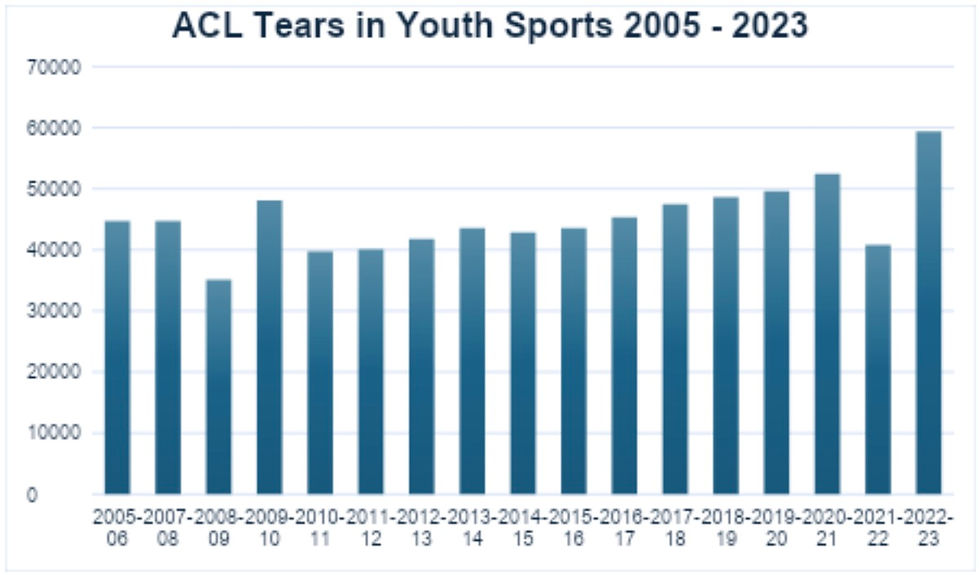
ACL Tears in Youth Sports 2005-2023. Data pulled from the high school RIO data collection program.
For someone who has experienced a traumatic injury, putting the parts back in place and rehabilitating them is Step One of a successful return to a normal life. The often-overlooked but critical Step Two is integrating those parts to function cohesively as a whole. Yes, rehabilitation is supposed to feature functional training, but it doesn’t always do so.
How many return to ADLs, able to deadlift 75% of their body weight?
Movement Restoration does not have cookie-cutter protocols. Each client’s experience with me differs, even though some of my methods might be the same. Each approach is unique as the foundation of Movement Restoration lies within the client and their unique body, history, and lifestyle. Time is valuable, but client outcomes take precedence. That is not how it is in most physical therapy practices. Again, it’s not their fault; they are merely adapted to the system that pays them.
As a Certified Strength and Conditioning Specialist and a Movement Restoration Specialist, my role is to help individuals who are structurally intact but functionally compromised regain proper movement and functionality.
How does Movement Restoration work?
A Movement Restoration session begins with a comprehensive assessment. Those with poor shoulder function will undergo a shoulder function assessment. The same goes for hips, knees, ankles, etc. Someone walking in without any major problems will go through a total body assessment, which evaluates their ability globally and is joint-by-joint. By looking at the body in this way, the chances I’ll miss something are minimized.
Unrestricted by insurance company regulations, I can take a holistic, integrated approach - such as conducting a hip assessment for a shoulder dysfunction case.
All I do is put my clients in the positions they need to be put in with the correct amount of resistance in the right planes of movement. My methodology restores my client’s mobility, stability, strength, and eventually, their faith in their body’s ability to function even under stressful loads.
The secret to my approach is my understanding of what someone is supposed to be able to do. When they aren’t able to do something, I break that movement down into its constituent parts to identify the issue. Which joint(s) are the issue? Which muscle(s) are the issue? Is mobility, stability, or strength missing?
Once I’ve identified the cause of dysfunction, I instruct the correct stretches and/or exercises to restore local movement. Next, I reassess the original compromised movement, which is usually improved. If it hasn’t improved, I repeat the process until we succeed.
Once my client achieves a baseline level of function, I introduce them to strength training in functional movements. My favorite movement is the Deadlift. Almost every single session I conduct features a Deadlift with a challenging weight. There is nothing more functional than picking something up off the ground. It is one of the few fundamental movements we still do daily and is, therefore, the most crucial movement to be restored.
As Po would say, “There are no secret ingredients,” just the right things done at the right times. And yes, the proof is in the pudding. If you have a look at my case studies, you’ll see that the pudding is delicious.
Too good to be true?
The results I’ve been able to get are astounding. I estimate an average of a 75% restoration of function in the people I work with after only one session. The only time I see significant decreases in this metric is when clients come to me post-surgery. It doesn’t matter if it’s been 6 months or 6 years; when fascia are cut, it is very challenging to get them functioning correctly again. But when my clients dedicate themselves, we get awesome results, whether post-surgery or not.
Ready to restore your movement?
If you are located in the Captial Region, NY, contact me via email Ben@brickmanmovement.com to arrange an appointment for an assessment.
If you are unable to schedule a personal session with me, visit my YouTube channel where I share my methods and exercises regularly. Subscribe so you don’t miss anything!


Comments